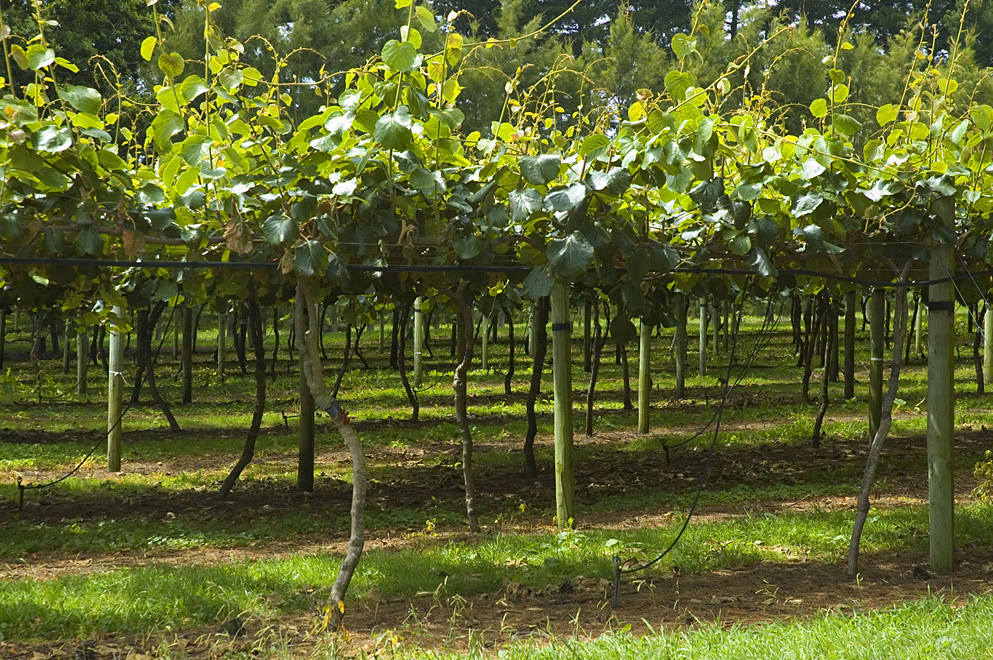
We work alongside growers from establishment through to export — trialling varieties extensively in each new environment and drawing on a decade of accumulated technical knowledge when new markets are developed.
Where it makes sense, we partner with local groups who hold regional PVR ownership and build agronomy expertise on the ground, as we have done so successfully in South Africa.
Meet the support team →The two most popular commercial varieties are Actinidia deliciosa (green kiwifruit) and Actinidia chinensis (gold kiwifruit).
Gold cultivars are softer, sweeter and less hairy than green types like Hayward, and consistently fetch better prices in the market.
Kiwifruit plants are gendered — both are needed in any orchard.
Complete lists of female and male cultivars are available to licensees in the SNZI variety details.
Kiwifruit thrives commercially in China, Italy, New Zealand, Chile, Greece, France, Central California and South Africa. Below are the conditions that distinguish a viable site from a marginal one.
Deliciosa needs 700 chilling hours below 7°C (44°F), gradual fall cooling without severe freeze, 240 frost-free days, minimal wind. Chinensis requires only 150 chilling hours or less below 7°C.
Available irrigation, not just rain. More water is needed than for grapes or peaches — ET coefficient of 1.1 — and the ability to irrigate more than once per week across six summer months.
Good drainage, low salinity (EC < 0.5 micromhos). Mounding recommended to keep roots out of waterlogged ground.
Good T-bar or pergola trellis able to carry vines and fruit weighing 150 kg per vine.
Kiwis thrive in hot summers up to 40°C (104°F); 35°C (95°F) is optimal. Sites at the higher end need 8,000–10,000 gallons per acre daily.
Kiwifruit tolerate winter frosts while dormant and adjust to lows of −6°C (21°F). Late spring frosts are a different story — kiwifruit leaf out early and young shoots are not frost resistant.
Full sun preferred; moderate shade tolerated.
Medium.
5.5 to 7.2.
A reference document covering kiwifruit propagation and plant production in more depth.
Download the production PDF →Tell us about your site and we'll help you choose varieties and plan your trial.